Company announcements turn into employee LinkedIn content when AI platforms like ekko embed corporate knowledge, compliance rules, and individual voice into daily posts for every leader and sales professional.
What Will You Accomplish With This Guide?
This guide shows corporate communications teams and executive leadership how a single platform turns scattered posting habits into a structured system for employee LinkedIn content. Marketing leaders gain a repeatable method for pushing corporate announcements to every team member’s personal network, rather than relying on a brand page alone. Readers finish with a clear framework for building employee advocacy content that sounds authentic instead of corporate. The stakes are real. Leaders who stay invisible on LinkedIn cede that trust gap to competitors whose teams post consistently. Bandwidth, not willpower, is usually the blocker. Executives know they should show up on LinkedIn. Daily demands crowd out writing time, and outsourcing the work to a ghostwriter runs pricing varies or more per month.
By the end of this guide, readers will know how to:
- Route company news on LinkedIn through every employee’s profile instead of a single corporate channel.
- Give each leader and salesperson a daily post written in their own voice, generated from one AI platform rather than a freelance writer.
- Carry launches, events, and milestones through the entire organization automatically, so no announcement dies in a shared drive.
- Build sustainable employee social sharing habits without adding headcount or recurring ghostwriting fees.
Why Does Employee Advocacy Content Outperform Brand-Only Posts?
Buyers read posts from people they recognize, not logos they scroll past.
What Does Successful LinkedIn Content Distribution Require?
Successful LinkedIn content distribution requires a system that pairs each person’s authentic voice with corporate knowledge and compliance guardrails. Without that pairing, posting stalls after the first few weeks, and announcements never reach the audiences employees’ networks could deliver.

What Do You Need Before You Start?
Three things matter before any team launches employee LinkedIn content: a knowledge base, a compliance framework, and buy-in from the people expected to post. Each daily post gets built by combining corporate knowledge, compliance rules, and a contributor’s personal voice development, and none of those three pieces can be skipped at setup. Leaders also need to confront the barriers that keep posting from happening in the first place: bandwidth, cost, design skill, and time all stop good intentions before they turn into published content, and a platform built to remove those barriers only works if the organization identifies which ones hit hardest.
Why do employee advocacy programs stall before launch?
Low employee confidence blocks most programs before the first post goes live. Teams without a clear plan or defined compliance guardrails hesitate to share anything under their own name, fearing missteps. Addressing that hesitation up front, not after launch, determines whether the program gains traction.
Before rolling out corporate announcements or company news on LinkedIn through a team-wide system, leaders should confirm:
- Corporate knowledge is documented. Product details, brand positioning, and talking points need a central source.
- Compliance rules are defined. Legal and communications teams should set boundaries before content generation starts.
- Distribution runs through official channels. Posts should route through LinkedIn’s own APIs to keep sharing secure and compliant.
- Confidence gaps get named. Surveying employees about hesitation surfaces blockers before they stall adoption.
Does every employee need to write their own posts?
No. Employee advocacy content works best when voice development happens alongside a contributor, not in isolation. The goal is a post that sounds like the individual without requiring them to draft it from scratch.
How Do You Audit Your Current Announcement Flow?
An announcement audit starts with mapping every step between a company update and a published post. Teams that skip this step keep losing visibility they never recover. Gaps in the process compound with every missed launch or milestone. Marketing teams rarely have the staff to turn each update into individualized employee LinkedIn content. That bandwidth gap stalls distribution before it starts. Executive posts often wait behind campaigns and events in the same queue. Leadership updates ship late or get stripped down to generic phrasing. Both failures point to the same root cause: no defined, repeatable process for moving corporate announcements from inbox to feed.
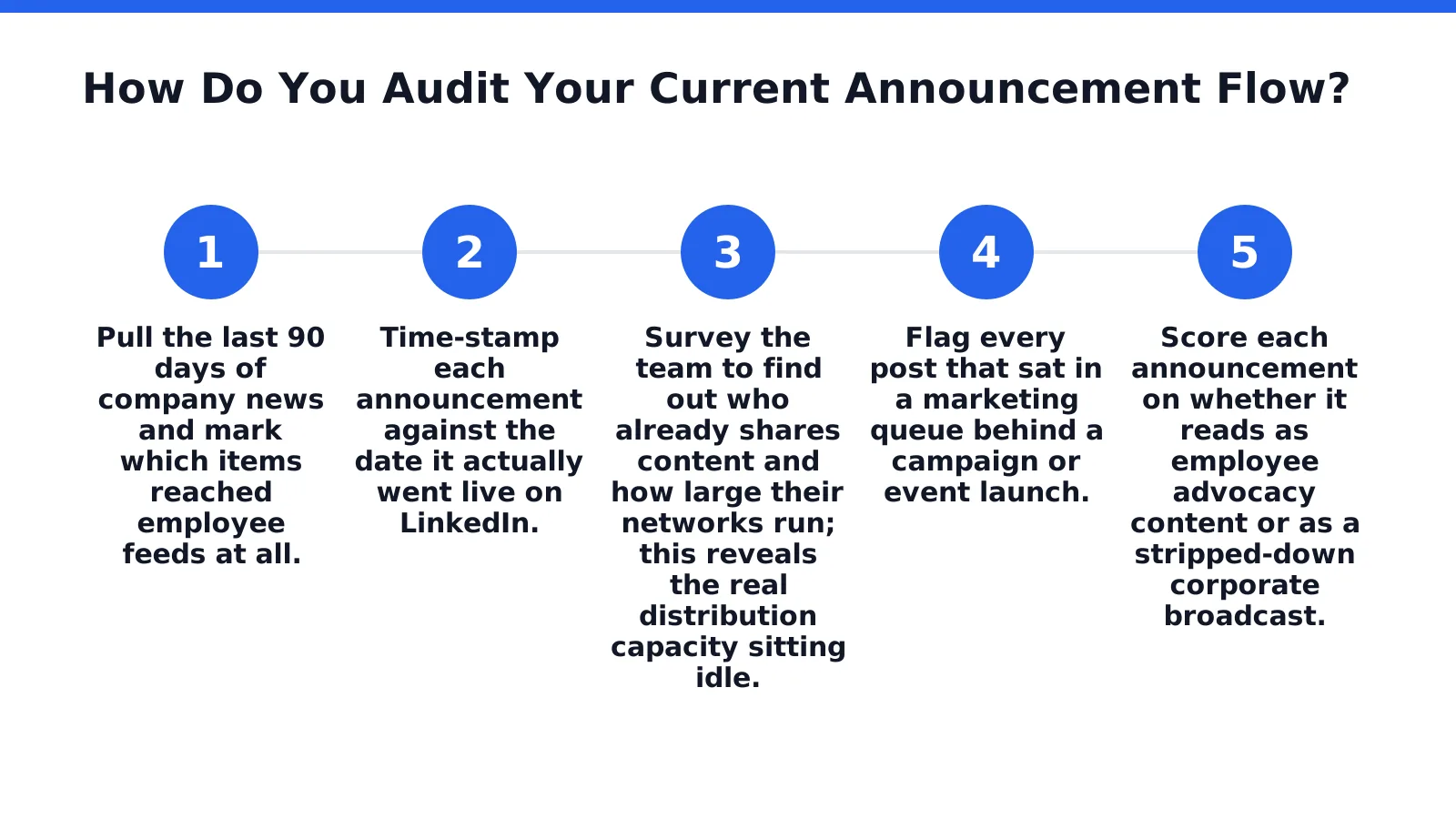
Run the audit in this order:
- Pull the last 90 days of company news and mark which items reached employee feeds at all.
- Time-stamp each announcement against the date it actually went live on LinkedIn.
- Survey the team to find out who already shares content and how large their networks run; this reveals the real distribution capacity sitting idle.
- Flag every post that sat in a marketing queue behind a campaign or event launch.
- Score each announcement on whether it reads as employee advocacy content or as a stripped-down corporate broadcast.
Why Do Advocacy Programs Stall Without a Process?
Most marketing teams struggle to get employees participating in an advocacy program when no clear workflow exists. Without defined steps for sourcing, approving, and routing updates, employee social sharing depends on individual motivation instead of structure, and motivation fades fast.
What Does a Healthy Flow Look Like?
Company news on LinkedIn moves within days, not weeks, and reaches multiple employee voices, not just one branded account. A healthy LinkedIn content distribution process treats every announcement as raw material for dozens of individualized posts, not a single corporate update competing for attention in a crowded feed.
How Do You Translate Corporate News Into Personal Posts?
Translation starts with separating the announcement from the angle. A product launch, a funding milestone, or a new partnership belongs to the company. The way a sales professional or team leader frames it belongs to the individual. Employee advocacy content works because people do business with people they know, like, and trust, not with logos. A press release reads like a logo talking. A post from a named team member reads like a person sharing something that matters to them.
The practical steps follow a clear order:
- Identify the core corporate fact, the launch date, the stat, the partner name, before any rewriting begins.
- Match that fact to a voice already established for the individual posting it, so tone stays consistent with past posts.
- Rebuild the announcement as a first-person observation rather than a bulletin, swapping “The company announced” for “I’m proud to share.”
- Route the finished post through approval and compliance checks before it reaches a personal feed.
Corporate announcements handled this way stop looking like broadcasts and start looking like endorsements. Platforms built for this pairing, like ekko, combine daily individual content with company-wide company news on LinkedIn, giving sales teams a steady supply of posts that carry both personal and corporate messages without extra writing hours.
Why does personal framing matter for reach?
Reach follows trust, and trust follows relationships, not corporate accounts. Having employees carry brand messages is a strategic, sustainable way to expand reach with prospects and stakeholders who already follow them. A single executive account broadcasting news reaches a fraction of the network that a full team, each posting the same update in their own words, reaches collectively.
What happens without this translation step?
Without it, corporate news sits in a press release nobody outside the company reads. LinkedIn content distribution stalls, pipelines lose visibility, and competitors with active teams absorb the attention instead.
How Do You Build Compliance Into Every Post?
Compliance gets built into employee LinkedIn content through engineered templates and approval steps, not through manual review of every draft. ekko runs on infrastructure engineered by CAP Digisoft, a Dallas-based engineering firm with two decades of reliability and security work behind it. That foundation shapes how employee advocacy content moves from draft to publish without creating new risk for communications teams.
The process follows a defined sequence:
- Each user’s voice and role inform a template engineered for consistent tone and structure.
- Compliance rules get embedded directly into that template, rather than applied after the fact.
- Generated posts route through a managed approval step before anything reaches a personal feed.
- Corporate announcements and individual posts alike pass through the same framework, keeping messaging aligned across the organization.
This structure removes the guesswork that normally slows down LinkedIn content distribution at scale. Marketing leaders don’t need to staff a review team to catch tone or messaging problems. The framework catches them by design, before a post ever reaches an approval queue.
Does Compliance Review Require Adding Headcount?
No. The managed service includes an approval process that works without additional internal staffing. Communications directors retain oversight of company news on LinkedIn without absorbing the workload of reviewing every individual post by hand.
What Makes the Infrastructure Trustworthy?
Trust comes from engineering history, not marketing claims. CAP Digisoft’s two decades of reliability and security work underpin the platform, giving executive teams a technical foundation built for authenticity and expertise rather than a quick plug-in tool. That history matters most when employee social sharing scales across dozens or hundreds of profiles at once. A single weak link in the compliance chain affects every post downstream.
How Do You Get Employees To Actually Share?
Employee sharing happens through buy-in, removed friction, and sustained momentum, not a single corporate memo. Getting colleagues to post consistently stands as a critical, though far from automatic, piece of any advocacy program. Companies that treat sharing as a one-off campaign watch participation drop within weeks.
Building durable employee advocacy content habits follows a repeatable sequence:
- Survey the team to find out why posts stall: low confidence, unclear messaging, or simply no time.
- Remove the specific blocker identified, whether that means supplying ready-to-post drafts or clarifying what’s safe to say publicly.
- Create buy-in by connecting participation to career visibility, not just marketing targets.
- Reinforce momentum with regular, low-effort prompts instead of sporadic asks.
This staged approach reflects a core truth: employee LinkedIn content only scales when leadership treats distribution as infrastructure, not a favor requested from busy staff. ekko builds on that logic directly, positioning a company’s people as its strongest channel and engineering posts that colleagues actually publish rather than ignore.
What Stops Employees From Sharing Content?
Hesitation, not disinterest, blocks most employee social sharing. Staff worry about sounding off-brand, lack confidence in their writing, or simply have no bandwidth to draft anything original. Removing those specific obstacles, rather than issuing another reminder, moves participation forward.
Why Does Advocacy Benefit Both Employee And Employer?
Advocacy delivers rewards on both sides of the relationship. Employees gain visibility and credibility within their networks, while the company gains reach it cannot buy through paid promotion alone. That mutual benefit is what sustains LinkedIn content distribution long after the initial launch excitement fades.
How Do You Measure Pipeline Impact?
Pipeline impact shows up in three places: reach, referral traffic, and sales-qualified engagement tied back to employee LinkedIn content. Revenue leaders track these numbers the same way marketing teams track campaign ROI. Social selling runs on the same math. LinkedIn reports that 94% of B2B marketers already treat the platform as their primary content distribution channel, which makes it the baseline for any pipeline measurement model. That same reliance explains why more than 50% of all social traffic to B2B websites and blogs originates on LinkedIn specifically, not across social platforms broadly.
Executive teams measuring LinkedIn content distribution should follow a consistent process:
- Baseline current employee posting frequency and reach before launching a program.
- Track referral traffic from LinkedIn to gated assets, demos, and pricing pages.
- Tag leads sourced through employee social sharing separately from brand-page leads.
- Compare quota attainment for sales reps active in employee advocacy content against those who are not.
- Review quarterly to confirm the effort still supports pipeline and quota goals, the core value of amplified social selling.
Why Does LinkedIn Matter More Than Other Channels?
Marketers rank LinkedIn above other social platforms for B2B results. 79% of B2B marketers consider LinkedIn an effective marketing channel overall, a figure that outpaces sentiment toward most other networks. That consensus gives revenue leaders a defensible reason to prioritize LinkedIn-first measurement over scattered, multi-platform tracking.
What Counts as a Pipeline Signal?
Sales-qualified replies, demo requests, and profile visits following a post all count as pipeline signals. Comms directors should log these alongside Corporate announcements and Company news on LinkedIn shared by employees. Reach from personal networks consistently outperforms brand-only posts.
What Mistakes Should You Avoid?
Four recurring errors derail most advocacy efforts before results show up. Leadership teams assume participation builds on its own, treat ghostwriting as a scalable fix, let announcements sit in a queue, and skip the compliance groundwork each poster needs.
Why Does Employee Advocacy Fail Without Structure?
Employee advocacy content rarely spreads on enthusiasm alone. Teams expect momentum to build once a program launches, but posting isn’t easy without a clear framework behind it. Consistency collapses once the initial push fades, leaving sporadic, low-quality posts instead of steady employee LinkedIn content.
Is Ghostwriting a Scalable Option for Teams?
Ghostwriters and agencies charge premium retainers for each executive they cover. That pricing model works for a single leader, but scaling it across a full leadership team and a sales floor makes the math collapse. Budgets built for a handful of polished voices rarely extend to broader employee social sharing at the team level.
Beyond staffing and cost, timing and governance create their own traps:
- Corporate announcements stuck behind other campaigns post late, generically, or never at all, draining urgency from launches and milestones.
- Company news on LinkedIn loses credibility when it arrives weeks after the fact instead of the day it happens.
- Skipping compliance frameworks tailored to each individual poster revives the same fear that stalls most LinkedIn content distribution programs before they start, freezing willing participants before a single post goes live.
Avoiding these four mistakes separates advocacy programs that compound results from those that quietly stall after launch.
FAQ
What stops leaders from posting consistently on LinkedIn?
Bandwidth, cost, design skill, and time block good intentions from becoming published content. ekko removes these barriers by generating daily, tailored posts automatically, eliminating the need for a pricing varies-per-month ghostwriter.
What do you need before launching an employee LinkedIn content program?
Successful programs require a knowledge base, a compliance framework, and buy-in from contributors. ekko combines corporate knowledge, compliance rules, and personal voice development into each daily post, ensuring none of these pieces gets skipped.
Conclusion
In closing, the shift from siloed corporate announcements to distributed employee voices represents a fundamental change in how organizations build credibility on LinkedIn. When your team members authentically share company news through their own networks, you amplify reach, deepen trust, and transform passive audiences into engaged communities. ekko removes the friction, compliance concerns, design overhead, time constraints, that typically blocks this approach, enabling your organization to maintain consistent visibility without sacrificing authenticity or operational bandwidth.