What Will You Accomplish With LinkedIn Voice Consistency, Brand Voice Consistency Across Employee Posts
What Will You Accomplish With LinkedIn Voice Consistency?
Teams that master brand consistency on LinkedIn unlock a trust advantage competitors cannot match through corporate posting alone. That gap defines the opportunity: companies that activate employees win attention corporate accounts cannot earn on their own.
Consistency also protects recognition. A unified brand voice consistency standard helps audiences identify a business wherever they encounter it, on LinkedIn, Instagram, or X. Executives and sales professionals lose that recognition the moment personal posts drift from company messaging, leaving followers unsure which account to trust.
Achieving this outcome requires a structured approach, not sporadic effort. Follow this sequence:
- Audit current employee posting activity to measure visibility gaps.
- Pair corporate knowledge and compliance rules with each employee’s established tone.
- Generate daily posts that reflect personal voice development, not generic templates.
- Route company announcements, launches, and milestones through the full employee network simultaneously.
- Review output against employee content guidelines before publication.
What Results Should Teams Expect From This Process?
Leaders and sales professionals gain a daily LinkedIn post written in their own voice, while announcements travel through the entire team at once. This structure solves the core tension between corporate messaging accuracy and individual authenticity. Sales teams in particular benefit, since consistent personal posting strengthens pipeline visibility without requiring new headcount.
How Does Automation Change the Outcome?
AI-generated LinkedIn posts built on corporate knowledge and compliance frameworks remove the guesswork from daily posting. Instead of ghostwriters or ad hoc drafts, each post stays aligned with brand standards while sounding like the person publishing it. LinkedIn content for employees becomes systematic rather than occasional, turning individual credibility into a repeatable, measurable distribution channel.

Why Does Brand Voice Consistency Matter on LinkedIn
Why Does Brand Voice Consistency Matter on LinkedIn?
Brand voice consistency determines whether an audience trusts a company or questions it. Executives who post without a repeatable system fall into a predictable pattern: bursts of activity followed by silence. That stop-start rhythm signals disorganization to the exact network a leader needs to win over.
The root cause rarely involves effort. Leaders understand the value of staying visible on LinkedIn, but marketing teams lack the bandwidth to produce daily material, and ghostwriters often charge premium monthly retainers. Even that spend frequently produces copy that sounds nothing like the executive behind it.
Inconsistency carries a steeper cost than a missed post. When tone and messaging shift from one touchpoint to the next, audiences stop recognizing the company they thought they knew. Ensure consistent brand voice across touchpoints; a fractured voice makes a brand feel like a cast of different characters rather than one trusted entity. Trust, once broken, is hard to rebuild.
That trust gap carries real financial weight. The same analysis found that 81% of consumers need to trust a brand before they will buy from it. For enterprise teams relying on LinkedIn content for employees to build pipeline, that statistic turns voice consistency into a revenue issue, not a style preference.
Does Inconsistent Messaging Really Affect Buyer Trust?
Yes. Buyers read mismatched tone as a warning sign, not a quirk. A single executive post that contradicts official corporate messaging forces an audience to question which version of the company is real.
Strong brand consistency requires a few non-negotiables:
- A defined voice for each leader, tied to one unified company narrative
- Employee content guidelines that scale without slowing posting cadence
- A review process that catches drift before it reaches the feed
What Do You Need Before You Start?
Four prerequisites determine whether a LinkedIn program succeeds: a defined voice, compliance-ready infrastructure, leadership buy-in, and clear content rules. Marketing leaders and employee advocacy managers who skip any of these find that posting stalls after a few weeks. CAP Digisoft, the Dallas-based engineering firm behind ekko, built the platform around the barriers that stop teams before they start: limited bandwidth, high ghostwriting costs, missing design skill, scarce time, and compliance fear. Teams need to define the brand voice itself before measuring brand voice consistency anywhere else, since that definition becomes the baseline every post, comment, and reply gets checked against going forward.
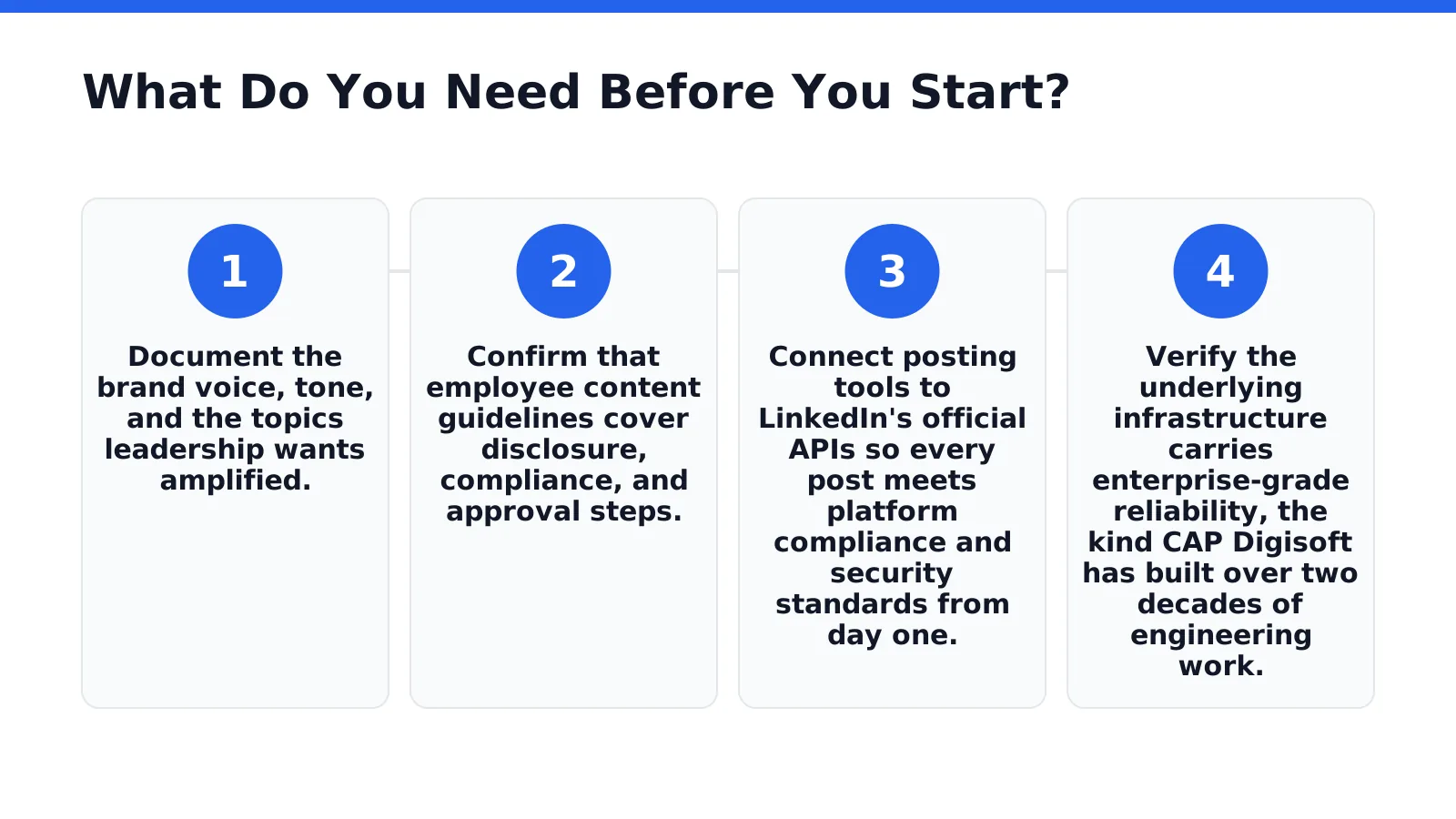
Complete these steps before activating a team on LinkedIn:
- Document the brand voice, tone, and the topics leadership wants amplified.
- Confirm that employee content guidelines cover disclosure, compliance, and approval steps.
- Connect posting tools to LinkedIn’s official APIs so every post meets platform compliance and security standards from day one.
- Verify the underlying infrastructure carries enterprise-grade reliability, the kind CAP Digisoft has built over two decades of engineering work.
Once those four steps sit in place, LinkedIn content for employees scales without legal or brand risk.
Does Every Employee Need Design or Writing Skills?
No employee needs design or writing skills to participate. AI-generated LinkedIn posts absorb company knowledge, compliance rules, and personal voice, removing the bandwidth and cost barriers that stall most programs before they gain traction. Sales leaders and communications teams still review the output; the platform handles the drafting.
Who Approves Corporate Messaging Before It Posts?
Communications teams typically retain approval authority over corporate messaging before it reaches employee feeds. That gatekeeping step protects brand consistency while still letting personal voice come through in daily posts.
How Do You Define Your Corporate Messaging Framework?
A corporate messaging framework starts with a clear definition of personality and tone, reflecting the core of a brand voice consistency standard. That definition must reflect company values and mission, not generic marketing copy. Enterprise teams and communications leaders build the framework before writing a single post. Tone decisions made late always require expensive rework.
Marketing leaders define the framework in four stages:
- Document the company’s values, mission, and approved vocabulary in one reference source.
- Translate those values into tone rules: formal versus conversational, data-driven versus story-driven.
- Build employee content guidelines that apply the tone rules to individual posts.
- Feed compliance rules and corporate knowledge into the content engine so every post stays aligned with sanctioned messaging, the same approach behind ekko’s platform architecture.
What Role Does Company-Wide Messaging Play?
Company-wide announcement sharing keeps leadership and sales teams repeating the same milestones instead of competing narratives. ekko’s offerings extend this framework across the organization. A product launch or funding announcement reaches every employee’s feed in a consistent voice. Sales leaders benefit directly, since prospects see aligned messaging from multiple people rather than a single corporate account.
Why Does Framework Consistency Matter for Recognition?
Recognition depends on repetition across every touchpoint. A Guide to Ensuring Brand Alignment Across All Content notes that when tone, style, and messaging stay consistent, target audiences begin to recognize and trust the brand wherever they encounter it. For enterprise teams running LinkedIn content for employees, this is the real measure of success: not post volume. Brand consistency that compounds with every share.
How Do You Build Employee Content Guidelines That Scale?
Scalable employee content guidelines combine engineered templates, a per-user compliance framework, and a managed approval process that governs every post without adding internal headcount. Enterprise teams need structure that travels across departments and seniority levels without collapsing into either rigid scripts or unmanaged chaos. The goal is simple: standardized output that still sounds like the person posting it.
What Belongs in a Set of Employee Content Guidelines?
Strong guidelines separate what must stay fixed from what should flex by platform and person. Corporate messaging and compliance rules stay fixed; tone, pacing, and personal anecdotes flex. Each channel calls for its own approach while still reflecting one consistent personality and communication style. Guidelines should name the non-negotiables once and leave room for individual expression everywhere else.
A workable framework typically addresses these layers:
- Define the compliance baseline. Lock in legal, regulatory, and corporate messaging requirements before any content gets drafted.
- Build engineered templates. Standardize structure and formatting so every post meets brand consistency expectations by default.
- Assign a per-user compliance layer. Match guidelines to each person’s role, seniority, and industry exposure.
- Route through managed approval. Require sign-off without creating a bottleneck or demanding new reviewers.
- Preserve individual voice. Protect room for personal phrasing so posts don’t read like corporate copy with a different name attached.
How Does Automation Keep Guidelines Consistent at Scale?
Automation enforces the rules so compliance doesn’t depend on memory or manual review, with platforms like ekko turning every team member into a trusted LinkedIn voice through daily, tailored content that maintains each person’s individual uniqueness inside a structure that still serves corporate objectives. This is the real scaling problem guidelines solve: a document alone doesn’t scale, but a document paired with automated enforcement does, and teams that skip that pairing end up back where they started, inconsistent, infrequent, and unmanaged.
How Do You Keep AI-Generated Posts On-Brand?
AI-generated LinkedIn posts stay on-brand when a platform combines corporate knowledge, compliance rules, and individual voice into a single generation engine. ekko builds that alignment into every post created for leaders and sales professionals, drawing on CAP Digisoft’s two decades of engineering experience to pair authenticity with security. The result is LinkedIn content for employees that reads like the person who posted it, not a marketing department speaking through them.
Maintaining that alignment requires a repeatable process, not a one-time setup. Enterprise teams achieve consistent output by following a structured sequence:
- Load corporate knowledge and messaging priorities into the platform before generating any posts.
- Apply compliance rules so every post meets legal and regulatory standards automatically.
- Capture each professional’s writing patterns to personalize tone without losing structure.
- Route generated drafts through an approval step before anything publishes.
- Review published posts periodically to confirm voice and corporate messaging stay aligned across the team.
This sequence keeps brand voice consistency intact even as dozens of employees post daily. The system enforces guardrails at the input stage rather than correcting mistakes after publication.
Why does employee-generated content need guardrails?
Guidelines prevent drift between what a company says publicly and what employees post individually. Without employee content guidelines, a sales professional’s casual post can contradict a formal company announcement within the same week. ekko closes that gap by embedding compliance logic directly into generation, so brand consistency survives at scale.
Does personalization compromise brand standards?
Personalization and brand standards are not opposites; they operate on different layers. CAP Digisoft’s infrastructure behind ekko handles tone, phrasing, and cadence at the individual level. Compliance rules hold company-wide standards fixed underneath. A strong social voice is never accidental. It gets engineered deliberately, post by post, to earn trust and credibility over time.
How Do You Review Posts Without Bottlenecks?
Bottlenecks disappear when an approval process runs without adding internal headcount, keeping content reach appropriate and aligned to corporate objectives. Manual sign-off creates the opposite result: leaders’ posts become one more request in a queue already full of campaigns, launches, and events, and the backlog only grows from there.
LinkedIn content for employees needs a review step that moves at the speed of the feed, not the speed of a committee calendar. Employee content guidelines set the boundaries ahead of time, so reviewers check against a fixed standard instead of debating tone case by case. Routing every post through LinkedIn’s official APIs keeps that review compliant and secure by design, rather than relying on screenshots or manual uploads.
Follow this sequence to review posts without creating a backlog:
- Define employee content guidelines before any drafts circulate, covering tone, claims, and topics to avoid.
- Generate AI-generated LinkedIn posts against those guidelines, so reviewers start from an on-brand draft, not a blank page.
- Route each draft through LinkedIn’s official APIs, which enforce security and compliance checks automatically.
- Approve content through a managed process that skips adding internal review staff.
- Publish on a steady cadence, confirming reach stays aligned with corporate objectives.
Does Automated Review Replace Human Judgment?
No. Automated checks catch tone and compliance issues before a post ever reaches LinkedIn, flagging language that drifts from guidelines or violates a stated rule. Human judgment still decides what a rulebook can’t: how a sensitive topic gets framed, whether a claim needs more context, or when a leader’s post calls for a more personal touch. Automation handles the repeatable work at scale; people stay responsible for the calls that need real judgment.
What Mistakes Break Brand Consistency on LinkedIn?
Four recurring errors undermine brand voice consistency for enterprise teams on LinkedIn. Outsourced ghostwriting, copy-paste captions, unmanaged tone drift, and inconsistent posting cadence each erode trust at scale, not just in isolated posts.
Many corporate communications teams outsource executive visibility to ghostwriters and agencies. These vendors charge premium retainers per executive. That cost compounds fast across a full leadership bench and an entire sales floor. The math collapses before the content even reaches a feed.
A second mistake treats every platform the same way. Teams copy one caption across channels, assuming identical wording guarantees identical corporate messaging. Consistency demands more than matching text; it requires matching personality, pacing, and intent across formats.
Why does inconsistent tone hurt engagement?
Audiences notice when a brand sounds like several different people. Without unified employee content guidelines, followers start feeling like they’re dealing with separate characters instead of one recognizable company. That confusion weakens the trust buyers need before engaging further.
Why does posting stop after a strong start?
Most leadership and sales teams rely on manual bursts rather than a repeatable system. Posting ramps up around a launch or event, then quietly stops once the initial motivation fades. Brand consistency requires a structure that survives beyond the first week of enthusiasm.
Common failure points include:
- Hiring outside writers whose retainer costs scale faster than headcount
- Duplicating captions instead of adapting tone per platform
- Letting individual voices drift without shared guardrails
- Depending on willpower instead of a repeatable posting system
Fixing these patterns separates LinkedIn content for employees that compounds reach from efforts that fizzle after one quarter.
FAQ
How does ekko maintain brand voice without policing individual tone?
ekko embeds corporate knowledge, compliance standards, and each professional’s personal voice directly into daily post generation. This produces content that stays aligned with brand standards while sounding authentic to the person publishing it.
Why does employee advocacy outperform corporate-only LinkedIn messaging?
Activating employees lets companies win attention that corporate accounts alone cannot earn.
What happens when employee posts drift from company messaging?
Audiences lose the ability to recognize a business across LinkedIn, Instagram, or X. Executives and sales professionals lose trust the moment followers become unsure which account to believe.
Conclusion
In closing, maintaining brand voice across employee LinkedIn posts isn’t a constraint; it’s a competitive advantage. When your team shares authentic, consistent content rooted in corporate knowledge and personal expertise, buyers recognize genuine authority over corporate broadcasting. ekko eliminates the friction between individual authenticity and organizational alignment, transforming every post into a trust-building asset. The result: visibility that scales without sacrificing the human credibility that drives real business outcomes.