

Most companies know their executives should be visible on LinkedIn. Buyers trust people more than logos, and a CEO or sales leader with a steady presence opens doors that a company page cannot. The trouble starts when one executive becomes five, or fifteen.
One ghostwriter can manage one leader. Ask the same setup to cover a whole leadership team and the cost, scheduling, and review cycles stack up fast. Many teams respond by hiring more writers. There is a better path: build a system that does the heavy lifting, so each executive spends minutes instead of hours. This guide explains why executive LinkedIn content breaks down at scale, what the real costs are, and how to scale executive LinkedIn content without growing your writing headcount.
Why Does Executive LinkedIn Content Break Down as You Scale?
A one-executive program is mostly a writing task. A multi-executive program is an operations task. That shift catches many marketing teams off guard.
What changes when you add more leaders?
Every new executive adds:
- Another calendar to work around
- Another voice to learn and protect
- Another set of topics, stories, and opinions
- Another round of review and sign-off
- Another chance of an off-brand or non-compliant post
Without a system, the workload multiplies with each person. The marketing team becomes the bottleneck, drafts arrive late, and posting happens in bursts and then stops. Consistency is what builds an audience, and it is the first thing to go.
Why do good intentions fail against a busy calendar?
Executives know visibility matters. But a good post takes 30 to 120 minutes to angle, draft, format, and pair with a visual. That block rarely exists in a leader’s week. When posting depends on willpower, it loses to board meetings and customer calls.
What Does It Really Cost to Hire More Writers?
Ghostwriting services
Hiring looks like the obvious answer, and it is rarely the efficient one.
Ghostwriters often charge premium Ghostwriters often charge premium retainers per executive, commonly $5,000 or more a month. Cover five leaders and the budget is gone fast. Each executive also needs interview time, so the founder who had no time to write now has no time for the writer either.
In-house writers
An internal hire brings recruiting, onboarding, training, and management. A new writer must learn the products, the compliance rules, and each executive’s voice. That learning takes months, and it leaves with the writer if they move on.
Hidden costs that add up
- Interview time: every draft depends on executive input
- Review cycles: legal and brand teams check each post by hand
- Uneven quality: different writers set different standards
- Slow turnaround: timely topics go stale before they post
Here is how the three common approaches compare:
Why Is Executive Content Worth the Effort?

Because people trust people. 92% of B2B buyers trust individuals over corporate communications. A post from a sales director reads as insight, while a company page update reads as marketing. The same logic applies to sales. Social sellers create 45% more opportunities and are 51% more likely to reach quota. Leaders set the example, and when executives are visible, their teams are more likely to follow. For more on getting a whole team involved, see our guide on employee advocacy on Linkedin
The goal is not more content for its own sake. It is steady, credible visibility from the people buyers want to hear from.
How Can You Scale Executive LinkedIn Content Without Adding Writers?
The idea is simple: move the repeatable work from people to a system. Six building blocks make that possible.
1. Create one source of truth for company knowledge
Write down your offerings, positioning, approved claims, proof points, and preferred terminology once. Every draft then pulls from the same facts, so ten executives never contradict each other. This is the same idea behind an AI profile brain for social media drafting.
2. Set the compliance rules once
List restricted topics, regulated language, confidentiality rules, and disclosure standards. Guardrails applied before a draft is written work better than catching mistakes afterward. Our post on LinkedIn content approval best practices covers how to structure this.
3. Let AI draft in each executive’s own voice
Generic AI makes every leader sound the same, and buyers notice. A better setup learns each person’s sentence length, hook style, favorite phrases, and topics, then drafts in that cadence. You can read more in AI platform for LinkedIn posts in your own voice.
4. Reduce executive effort to review and edit
The executive should not start from a blank page. A finished draft arrives in their inbox. They change a line, add a real story from the week, and approve. That is a few minutes, not an hour.
5. Route sensitive posts through approval
Some topics need a second pair of eyes: financial results, legal matters, customer names. Set those topics to route automatically to a manager, marketing, or legal approver, with a record of who signed off.
6. Carry company news through the leadership team
Prepare each announcement once, then let every leader share it in their own words. Launches, events, and milestones then reach far more people than a single company page post. See thought leadership at scale for how this builds consistency over time.
What Does a Scaled Executive Content Workflow Look Like?

Here is a simple example. A company launches a new product.
- Marketing prepares the announcement and approved facts once.
- The CEO posts about why the company built it.
- The sales leader posts about the customer problem it solves.
- The CTO posts about how it works in plain language.
Three leaders, one launch, three different voices and angles. No one waited for a writer, and no one had to chase approvals by email.
A daily rhythm for each executive can be just this:
- Open the morning draft
- Edit or add a personal detail
- Approve and publish, or send for review
- Spend a few minutes replying to comments
How Do You Keep Executive Posts Authentic When AI Helps?
Authenticity comes from the executive’s real experience, not from who typed the first draft. AI handles structure, hooks, and formatting. The person adds the substance.
To keep posts genuine:
- Add one real example, story, or number from your own work
- Say what you actually think, even if it is a small opinion
- Read the post aloud and change anything you would never say
- Never publish a draft you have not read
Buyers can tell when a post is scripted. A short, honest line from a leader beats a polished paragraph that sounds like a committee wrote it.
How Do You Protect Brand Consistency and Approval at Scale?
Brand consistency does not mean everyone sounds the same. It means everyone uses the same facts, follows the same rules, and stays on message, while keeping their own voice.
A growing communications team typically needs:
- A managed approval process that checks sensitive posts before they go live
- Corporate guidelines enforced without extra headcount
- Published content that matches current company priorities
- A clear record of who approved what
When these sit inside the same system that creates the drafts, compliance stops being the reason leaders stay silent. It becomes the reason leadership can say yes.
Common Mistakes When Scaling Executive LinkedIn Content
- Launching with every leader at once. Start with a small pilot and expand.
- Copying one post to every executive. Same facts, different voices.
- Skipping approval to move faster. One wrong claim can cost more than a week of silence.
- Treating LinkedIn as broadcast only. Replies and comments build the relationship.
- Judging success by likes alone. Track conversations, profile views, and meetings started.
- Stopping after a few weeks. Visibility compounds only with consistency.
How ekko Helps Scale Executive LinkedIn Content
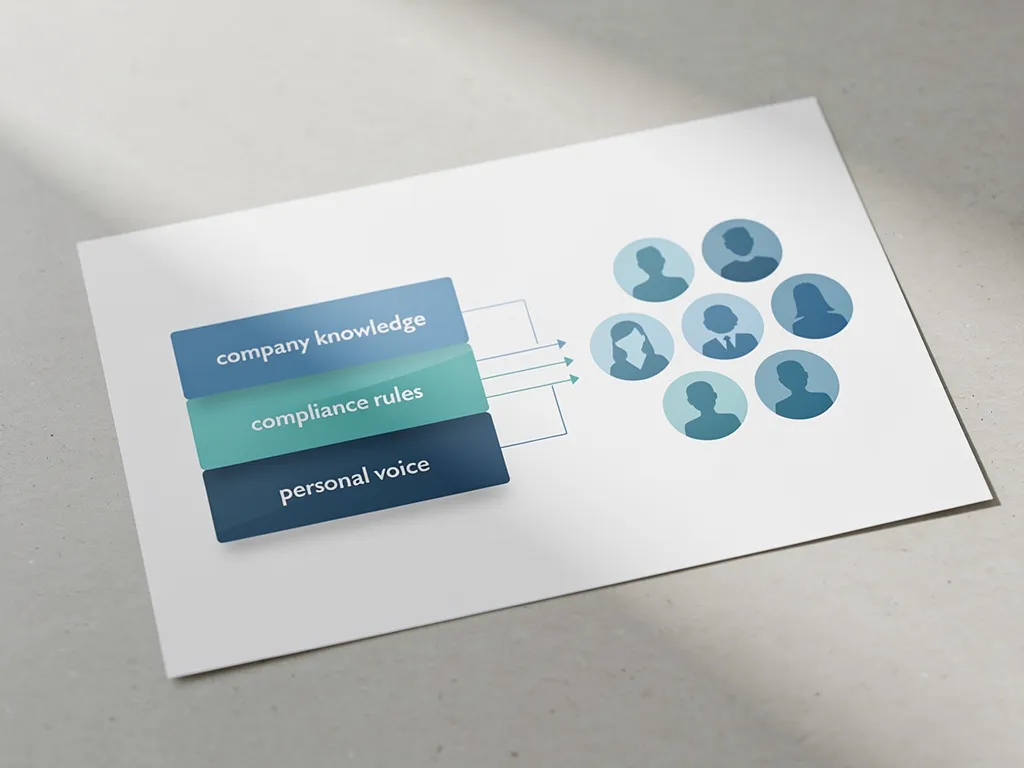
ekko gives every leader and sales professional a daily LinkedIn post in their own voice, and carries company announcements through the whole team. It does this with three layers working together:
- Company knowledge: your approved offerings, positioning, and claims
- Compliance rules: restricted topics and regulatory language enforced before drafting
- Personal voice: each person’s private voice model, built from their LinkedIn history
Posts publish directly to each profile through LinkedIn’s official integration, with no copy-paste and no plugins. For sensitive topics, ekko routes drafts to the right approver and tracks sign-off, and companies that want human review without staffing it can also use an optional managed review desk from CAP Digisoft, the Dallas-based team behind ekko. The result is steady executive visibility without a writer for every leader, and you can see how it works with a team pilot.
Frequently Asked Questions
How can I scale executive LinkedIn content without hiring more writers?
Move the repeatable work into a system: a shared company knowledge base, set compliance rules, AI drafts built on each executive’s voice, and an approval workflow. Executives then review and approve instead of writing from scratch.
How much time does an executive need to spend on LinkedIn each day?
With ready drafts, only a few minutes: read, edit a line or add a personal detail, and approve. Time spent replying to comments is separate and is worth protecting.
Will AI-written executive posts sound like the executive?
They can come close when the AI learns from the person’s own past posts, such as sentence length, hooks, and common phrases. A human review is still essential, and adding a real story or opinion makes the post genuinely theirs.
How do we keep executive LinkedIn posts compliant?
Define restricted topics, confidentiality rules, and approved claims once, then enforce them before a draft is written. Add an approval step for sensitive topics, with a record of who signed off.
How many executives should we start with?
Start with three to five leaders who are willing to post. Learn what works, tune the workflow, then expand to the wider leadership team and sales floor.
Conclusion
Scaling executive LinkedIn content is not a writing problem. It is a systems problem. Hiring a writer for every leader raises cost, adds interview time, and still leaves gaps when anyone is busy.
A better approach captures your company’s facts, sets your rules once, drafts in each leader’s own voice, and keeps approval simple. Executives stay visible and credible, marketing stays in control, and the team grows its reach without growing its writing headcount.
If you want to see this in practice, explore ekko and run a pilot with your leadership team.