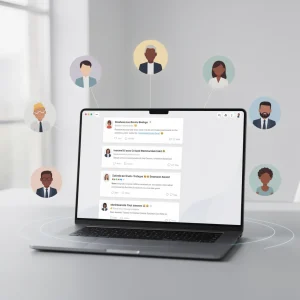
A LinkedIn ambassador program mobilizes employees to share company content, building reach beyond brand-only posts. Platforms like ekko, a LinkedIn Authorized Development Partner, generate daily AI-assisted posts in each employee’s voice, embedding compliance rules and corporate knowledge.
Why Do Employees Outperform Brand Pages?
Individual employees outperform brand pages because people trust people faster than they trust logos. A sales director’s post catches attention that a corporate feed never earns. Recognition starts with a human face, not a stylized mark.
A corporate LinkedIn strategy built only around company pages leaves this trust gap unaddressed. Employee-generated content closes it by routing every launch, milestone, and client win through real names instead of anonymous handles. A report on employee brand ambassador programs found that LinkedIn drives a substantial share of all social media traffic reaching company websites, a channel most organizations never fully activate.
Does an ambassador program actually change outcomes, or just activity?
Outcomes shift measurably. The same report found that organizations running structured advocacy programs see brand consistency scores climb by 30%. Campaign launch times shrink from weeks to days once employees carry messaging instead of waiting on a single marketing queue.
What does this mean for sales and marketing leaders?
A LinkedIn ambassador program turns scattered individual posting into coordinated employee thought leadership. Sales directors stop waiting on design requests. Marketing executives stop bottlenecking every announcement through one channel.
An employee advocacy program built on LinkedIn employee advocacy principles treats every team member as a distribution channel, not a spectator. That shift explains why brand pages alone cannot compete: logos do not build trust, people do.

What Can Campus Programs Teach Enterprise Teams?
Campus-level programs reveal the blueprint enterprise teams need for a working corporate LinkedIn strategy. San Jose State University’s official LinkedIn partnership formalizes student advocacy through a dedicated LinkedIn ambassador program, giving participants structured training rather than ad hoc posting advice. That formal structure, not improvisation, is the lesson worth borrowing.
Structure separates a real employee advocacy program from a one-off request to “post more.” The university model pairs instruction with direct brand representation, building applied skills through hands-on practice rather than passive guidelines. HubSpot’s LinkedIn ambassador cohort follows the same logic: six weeks of live training combined with a four-week experiential project alongside an actual customer. Participants don’t just learn LinkedIn ad mechanics in theory; they apply them to a real account.
Why does structured training outperform casual encouragement?
Casual encouragement produces inconsistent output because employees lack a framework for what to post and when. Structured programs solve this by sequencing instruction before execution, then pairing that instruction with a live project. The result is skill transfer, not sporadic participation.
Enterprise teams can translate three campus-program principles directly into their own employee advocacy structure:
- Formal enrollment over informal asks. A named program signals priority; a stray Slack message does not.
- Applied projects over theoretical training. Real accounts and real campaigns build fluency faster than slide decks.
- Paired mentorship over solo output. Matching participants with experienced partners accelerates employee thought leadership development.
Enterprise LinkedIn employee advocacy efforts that skip structure tend to stall after the first few weeks, mirroring the burst-then-stop pattern leaders already recognize in their own organizations. Campus programs succeed because training and execution move together, not sequentially.
How Does Employee-Generated Content Fuel Pipeline?
Employee-generated content fuels pipeline because buyers respond to colleagues and peers faster than they respond to corporate accounts. Daily, voice-matched posts paired with amplified social selling give sales teams a direct line to quota and pipeline goals. Sales directors looking for measurable output from LinkedIn employee advocacy should expect this compounding effect, not a one-time spike.
Momentum builds on a predictable curve. Once an employee advocacy program takes hold, participation tends to double every quarter, according to reporting on brand ambassador programs. That growth pattern matters for enterprise marketing teams planning budget and headcount around advocacy. Adoption rarely stays apartment once a critical mass of employees starts posting.
Does AI-Generated Content Still Sound Authentic?
Authenticity survives automation when the technology preserves individual voice rather than flattening it. AI-generated posts built to maintain each person’s uniqueness let every team member operate as a trusted, compliant presence on LinkedIn. Corporate communications executives get consistent messaging without losing the personal tone that makes a post credible.
What Else Does Advocacy Improve Beyond Sales Pipeline?
Visible advocacy strengthens recruitment, not just revenue. Prospective hires see company culture through real employee voices and experiences, which carries more weight than a careers page. For employee advocacy managers, this is a second return on the same investment.
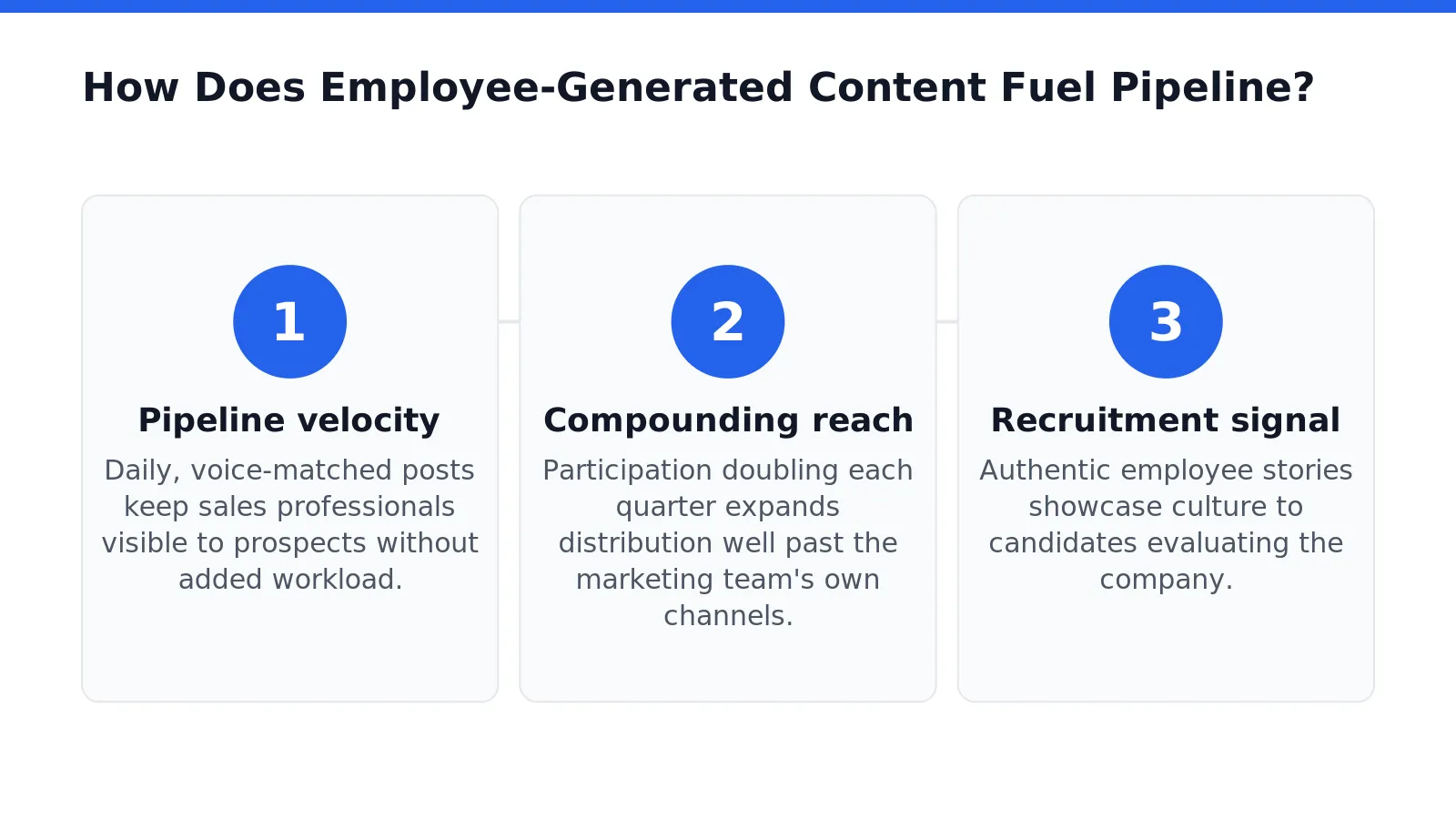
A corporate LinkedIn strategy built on this foundation delivers three distinct gains:
- Pipeline velocity: Daily, voice-matched posts keep sales professionals visible to prospects without added workload.
- Compounding reach: Participation doubling each quarter expands distribution well past the marketing team’s own channels.
- Recruitment signal: Authentic employee stories showcase culture to candidates evaluating the company.
Employee thought leadership turns individual credibility into a scalable asset. Marketing leaders stop depending on a handful of executives to carry the brand. Instead, the entire team becomes the distribution engine, and pipeline follows participation.

What Blocks Most Advocacy Programs From Scaling?
Three structural bottlenecks keep most advocacy programs stuck at pilot stage. Budget constraints, marketing queue congestion, and ghostwriting costs stall even well-funded initiatives before they reach a full leadership bench. The payoff for solving these problems is real: analysis of employee brand ambassador programs suggests that only a small share of businesses actually run these advocacy programs, despite the engagement advantage they produce. That gap between proven value and actual adoption signals a scaling problem, not a strategy problem.
An employee advocacy program fails for structural reasons, not motivational ones. Marketing teams carry campaign calendars, product launches, and event deadlines already. Leadership posting requests land as one more item in that queue.
Why does marketing lack bandwidth for leader posts?
Marketing departments rarely have spare capacity to write individualized content for every executive and seller. Requests for leader posts get buried behind campaigns already in motion. Posts that do get written often ship late, sound generic, or never ship at all.
How much do ghostwriters cost per executive?
Outsourcing solves the bandwidth problem but creates a budget one. Agencies and ghostwriters bill premium retainers, with pricing that varies by provider and scope.
Multiply that retainer across a leadership team and a sales floor, and the math stops working for most companies. A corporate LinkedIn strategy built on one-off ghostwriting simply doesn’t scale:
- Per-executive retainers compound fast across ten, twenty, or fifty leaders
- Output still rarely captures each person’s actual voice
- Queue-based production guarantees delay, not consistency
Scaling employee thought leadership demands a system, not another freelancer.
How Should You Structure a Corporate LinkedIn Strategy?
A sound corporate LinkedIn strategy connects two layers: individual leadership voice and company-wide news. Most leaders already know they should post regularly. Intent isn’t the problem. Bandwidth is. Marketing teams get buried under campaigns and events, ghostwriters charge premium monthly rates, and outsourced content often misses the leader’s actual voice. The gap between wanting visibility and achieving it is where most strategies collapse.
Structure closes that gap by treating consistency as an engineering problem, not a willpower problem. Blanket policies fail because they ignore how differently each person writes, thinks, and shares. Effective programs build templates and compliance frameworks around the individual, letting a sales director sound distinct from a finance executive while staying inside the same guardrails.
What should a corporate LinkedIn strategy include?
A working strategy includes three components: individual voice development, compliance infrastructure, and a shared announcement pipeline. Skipping any one of them creates either inconsistent output, security risk, or disconnected messaging between leadership and company news.
- Voice-specific templates: structure built around how each person actually communicates
- Compliance routing: posts move through LinkedIn’s official APIs rather than manual copy-paste workflows
- Security certification: information-security standards that satisfy legal and compliance review
- Centralized announcements: launches, events, and milestones distributed through the same system as personal posts
Why does compliance belong inside the strategy, not bolted onto it?
Compliance built in from the start prevents the approval delays that kill posting momentum. When posts route through official channels and carry recognized security certification, legal teams stop treating every post as a new risk review.
The strongest structure links individual employee thought leadership directly to the company’s broader announcements. One system, covering both layers, keeps the brand message and the personal voice moving together instead of competing for attention.
How Do You Build Employee Thought Leadership?
Building employee thought leadership requires a bridge between subject-matter expertise and consistent public visibility. Expertise alone stays invisible without a system that pushes it onto LinkedIn feeds every single day. Most companies have the first half of that equation already. They employ engineers, salespeople, and executives who know their industries cold. What they lack is the second half: a repeatable mechanism for turning that knowledge into public, individually voiced content.
Enterprise-grade infrastructure behind a content engine determines whether that output stays credible at scale. A platform built on two decades of engineering reliability treats security and consistency as foundational, not optional. That kind of backbone is what separates occasional posting bursts from a durable corporate LinkedIn strategy. Without it, authenticity and trust break down the moment a program grows past a handful of leaders.
What Does a Scalable Program Actually Look Like?
A scalable program delivers daily, individually tailored posts so each employee builds visibility without sounding like a press release. Content generation tuned to a single person’s voice keeps employee-generated content from reading as uniform corporate messaging. Sales directors, marketing leaders, and communications executives each need output that reflects their own tone, not a shared template.
Who Should Participate First?
Executives and client-facing sales professionals should lead any rollout, since their visibility carries the most buyer weight. A disciplined LinkedIn ambassador program then expands participation across teams without sacrificing voice or compliance. Structuring this rollout as a formal employee advocacy program, rather than an ad hoc request, keeps momentum from stalling after the first few weeks. The result: LinkedIn employee advocacy that compounds, and employee thought leadership that holds up under scrutiny.
How Does ekko Operationalize This Without Risk?
Risk gets engineered out at the infrastructure level, not patched in after the fact. CAP Digisoft, the Dallas-based engineering firm behind ekko, built the platform on two decades of reliability and security work. That history shapes how a corporate LinkedIn strategy gets executed day to day, not just how it gets designed on a whiteboard.
Every post travels through LinkedIn’s official APIs and ISO-certified information-security protocols. Marketing teams and advocacy managers lose the burden of manual compliance review. Content ships clean, every time, without a human gatekeeper checking each draft line by line.
Who approves the content before it goes live?
A managed approval process sits between content generation and publication. This structure keeps every post aligned to corporate objectives without forcing a company to staff up internally. Leaders and sales professionals get daily content; communications executives keep oversight, without adding headcount to manage it.
What makes this different from a typical employee advocacy program?
Most employee advocacy program efforts rely on manual coordination: spreadsheets, Slack reminders, inconsistent follow-through. ekko replaces that patchwork with a single system that handles voice, compliance, and distribution together.
The operating principle stays simple. A company’s people remain its most credible channel, and ekko builds the infrastructure to make them post accordingly. That means:
- Employee-generated content flows from real corporate knowledge, not generic templates
- Compliance rules get baked into generation, not bolted on after review
- Employee thought leadership scales across a sales team without each person needing a ghostwriter
The result: a LinkedIn employee advocacy system that behaves like infrastructure, not a side project. Security, compliance, and voice development run in the background, so leaders show up consistently, and communications teams never lose control of the message.
FAQ
What is a LinkedIn ambassador program?
A LinkedIn ambassador program mobilizes employees to share company content, extending reach beyond brand-only posts. Platforms like ekko generate daily AI-assisted posts in each employee’s voice, embedding compliance rules and corporate knowledge.
Why do employees outperform brand pages on LinkedIn?
A sales director’s post earns attention a corporate feed never does. Recognition starts with a human face, not a stylized mark.
What can enterprise teams learn from campus ambassador programs?
Campus programs show that formal structure outperforms casual encouragement, pairing instruction with hands-on practice instead of ad hoc posting advice. Enterprise teams can translate this through formal enrollment and sequenced training before execution.
Conclusion
In closing, LinkedIn ambassador programs succeed when authenticity drives distribution, and ekko removes the friction that prevents teams from becoming visible advocates. By embedding compliance, voice consistency, and daily content generation into a single platform, organizations transform bandwidth constraints into competitive advantage. The result: genuine employee voices amplifying corporate expertise at scale, without the overhead. That’s how modern visibility works.