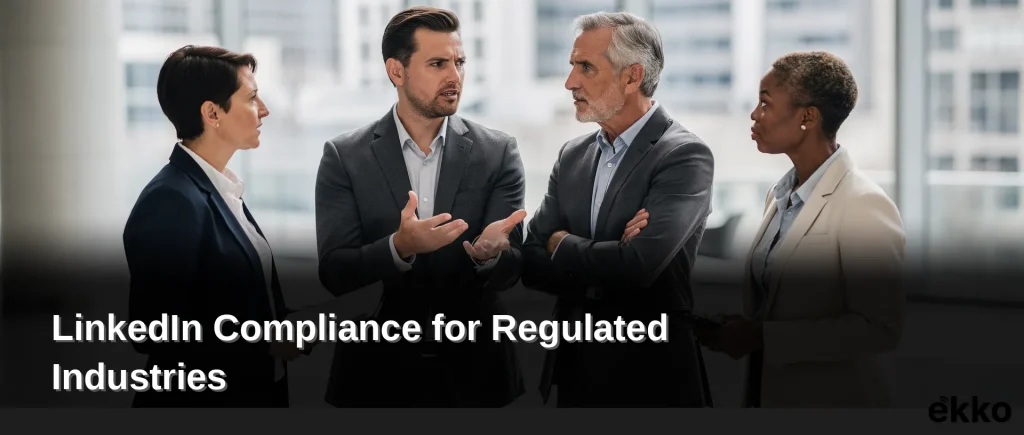
LinkedIn lets professionals share industry knowledge, build relationships, and establish credibility with potential customers. For companies in regulated industries, however, publishing content involves more than writing an engaging post. Every statement, claim, testimonial, and disclosure may need to meet specific legal, regulatory, and internal requirements.
LinkedIn compliance for regulated industries matters most when employees, executives, sales representatives, and subject-matter experts publish content about products, services, financial performance, healthcare, or other regulated activities. A post that seems harmless to one employee may raise compliance concerns for the organization.
The challenge is finding the right balance between employee visibility and organizational oversight. Strict controls can slow down content production, while an informal approach can leave employees uncertain about what they can safely share.
A structured process helps companies maintain oversight without preventing employees from participating in professional conversations. With clear guidelines, appropriate reviews, documented approvals, and the right technology, organizations can support consistent LinkedIn activity while managing risk.
Why Is LinkedIn Compliance Important for Regulated Industries?
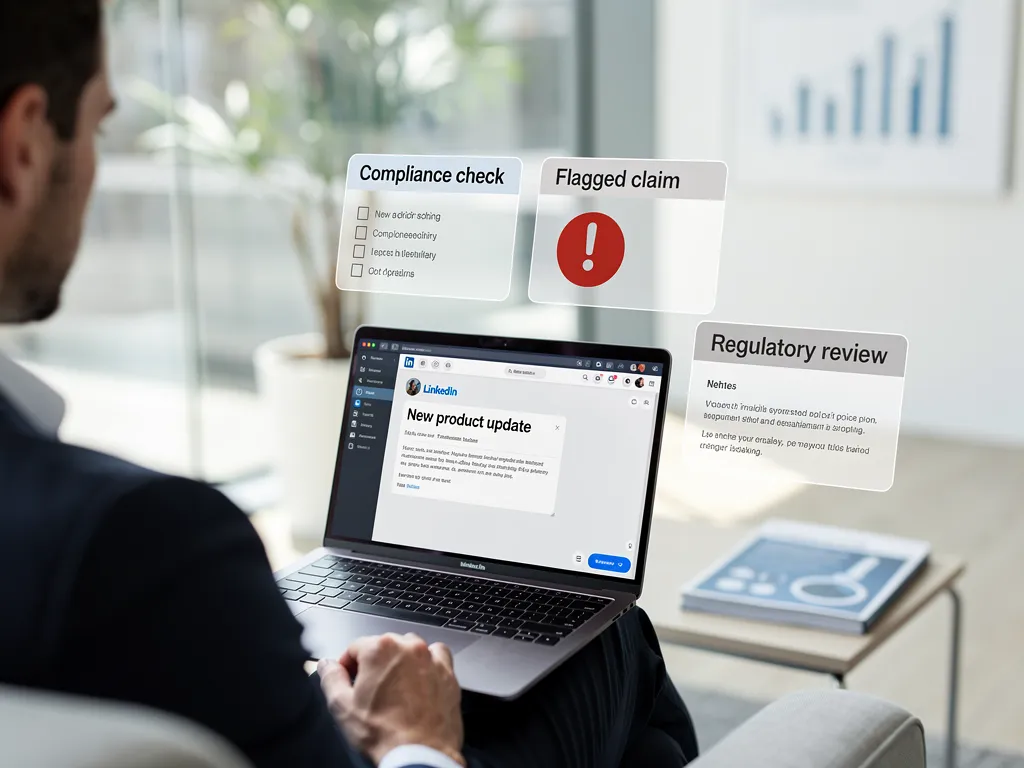
Regulated organizations operate under requirements that can affect how they communicate with customers, prospects, partners, and the public. Depending on the industry and jurisdiction, these requirements may govern advertising claims, financial promotions, patient information, professional conduct, disclosures, and record retention.
LinkedIn introduces additional considerations because employees often publish through their personal profiles. A post may express an individual’s opinion while also referring to the person’s employer, products, or professional expertise.
Several risks deserve attention.
1. Misleading or Unsupported Claims
Employees may unintentionally make statements that exaggerate a product’s benefits, promise particular results, or present an opinion as an established fact.
For example, a financial services employee might describe an investment as a guaranteed opportunity, or a healthcare professional might imply that a treatment produces the same result for every patient.
Organizations should establish rules for substantiating claims, using approved language, and avoiding guarantees that cannot be supported.
2. Confidential or Sensitive Information
Employees may share information about customers, patients, internal projects, financial results, or upcoming announcements without realizing that it is confidential.
A screenshot, customer success story, or seemingly anonymous example may reveal more information than intended.
Employees should understand what information must remain private and how to obtain permission before sharing customer stories or identifiable details.
3. Missing Disclosures
Some communications require disclosures about professional relationships, compensation, sponsorships, conflicts of interest, or other material connections.
The exact requirements depend on the context and applicable rules. A disclaimer alone does not make a misleading or otherwise noncompliant claim acceptable.
Companies should define which disclosures are needed, where they must appear, and who is responsible for checking them.
4. Inconsistent Messaging Across Teams
When employees independently discuss the same product or service, their descriptions can become inconsistent. Different wording may introduce unsupported claims or conflict with approved corporate messaging.
Clear content guidelines and a shared source of approved information help reduce these inconsistencies without requiring every employee to write in the same personal style.
Which Industries Need Special Attention?
The appropriate LinkedIn compliance process depends on what an organization does, where it operates, and which rules apply to its communications.
Financial Services
Financial advisers, investment firms, banks, and other financial organizations should consider rules governing advertisements, investment claims, testimonials, and customer communications. Employees should avoid unsupported performance claims, misleading comparisons, and promises of guaranteed returns, and organizations should determine when communications need supervisory review and retention.
Healthcare and Life Sciences
Healthcare providers, pharmaceutical companies, medical technology businesses, and life sciences organizations should protect patient privacy and manage claims about treatments, products, and clinical outcomes. Employees should never share identifiable patient information without proper authorization, and product statements should use approved, substantiated information.
Legal Services
Law firms and legal professionals must consider applicable professional conduct rules when discussing cases, clients, and legal outcomes. Public posts should not disclose confidential client information, create misleading expectations about case results, or imply guarantees, and organizations should review jurisdiction-specific requirements before setting their guidelines.
Insurance
Insurance professionals should ensure that descriptions of coverage, exclusions, eligibility, and benefits are accurate and not misleading. Employees should use approved information when discussing policies and avoid presenting general examples as guaranteed outcomes for individual customers.
Other Regulated Businesses
Pharmaceuticals, medical devices, energy, and other highly regulated sectors may have additional requirements around product claims, safety, public statements, or confidential information. The right approach is to identify the rules that apply to the organization rather than assuming one generic social media policy covers every situation.
How to Build a LinkedIn Compliance Workflow

A practical compliance process should establish what employees can publish, when approval is required, and how the organization documents its decisions.
Step 1: Create Clear Social Media Guidelines
Employees need specific instructions rather than a general warning to be careful online. A useful policy should explain:
Which topics employees can discuss independently.
Which claims require approved supporting evidence.
What customer, patient, financial, or confidential information must not be shared.
When disclosures are required.
Which posts need legal, compliance, or communications review.
How employees should report a mistake or request clarification.
Use examples relevant to actual employee roles, since sales representatives, executives, healthcare professionals, and marketing teams may need different guidance.
Step 2: Establish Approved Company Information
Employees should have access to reliable information about products, services, announcements, and approved messaging. Maintain current reference materials that identify approved claims, supporting evidence, required disclosures, and any restrictions on use, and assign ownership for reviewing and updating these materials, since outdated details can create problems even when employees follow the instructions they were given.
Step 3: Define Risk-Based Approval Requirements
Not every LinkedIn post carries the same level of risk. A general comment about an industry trend may require less oversight than a post discussing investment performance, patient outcomes, or a regulated product.
Lower risk: General professional insights that do not contain restricted claims or sensitive information.
Moderate risk: Product descriptions, company announcements, and customer success stories that require verification.
Higher risk: Financial promotions, healthcare product claims, sensitive disclosures, and content involving confidential or legally sensitive matters.
These categories are illustrative, not a universal regulatory classification. Each organization should determine its own review requirements with its compliance and legal teams.
Step 4: Review Claims, Disclosures, and Sources
Before approving a post, reviewers should check that factual statements are accurate, current, and supported by appropriate evidence:
Can the organization substantiate each important claim?
Does the wording imply a guarantee or outcome that cannot be promised?
Are necessary qualifications or disclosures included?
Does the post use approved product information?
Could a reader misunderstand the statement without additional context?
Reviewers should also check links, images, graphics, and attached documents, since compliance issues can appear in visual content just as easily as in written text.
Step 5: Document Approvals and Retain Required Records
An approval should be more than a quick message saying that a post looks good. Where required by applicable regulations or internal policy, retain the relevant draft, reviewer identity, approval decision, date, changes made, and final published version. Organizations should also establish how long records must be retained, who can access them, and how corrections or deletions are documented, since recordkeeping requirements vary by industry and jurisdiction.
Step 6: Train Employees and Review the Process
Policies work only when employees understand how to apply them. Provide examples of acceptable and unacceptable posts, explain common risks, and give employees a clear route for asking questions. Training should be updated when regulations, company policies, products, or communication practices change, and published content and approval records should be reviewed periodically to identify recurring mistakes and improve the process.
Step 7: Use Technology to Support Oversight
Managing drafts, reviews, and approvals through disconnected emails or spreadsheets can become difficult as more employees participate in LinkedIn content programs. A structured platform can help teams organize content, apply company guidelines, coordinate reviews, and maintain visibility into the publishing process. Technology should support the organization’s compliance framework rather than replace it, since automated checks and AI-generated suggestions cannot guarantee that every post meets all applicable legal and regulatory requirements.
How Can AI-Generated LinkedIn Content Stay Compliant?
AI can help employees develop ideas, organize information, and draft LinkedIn posts more efficiently. However, AI-generated content can also introduce inaccurate statements, unsupported claims, missing context, or wording that does not match approved corporate messaging. For regulated organizations, AI should operate within a defined content governance process.
Use Approved Company Knowledge
AI-generated drafts should draw on reliable, current company information. Product descriptions, service details, approved claims, and announcements should come from designated sources rather than assumptions, and employees and reviewers should verify important statements before publication.
Apply Compliance Rules During Drafting
Clear instructions can help guide AI away from prohibited language, unsupported promises, and restricted topics. Organizations can establish approved terminology, required disclaimers, and escalation rules for content that needs additional review, though these controls do not eliminate the need for human judgment.
Preserve Each Employee’s Writing Voice
Compliance does not require every LinkedIn post to sound like a corporate press release. Employees can communicate the same approved information using their own vocabulary, tone, and professional perspective, provided the content stays accurate and within organizational guidelines. This matters most for employee advocacy programs, where authentic individual voices help professionals share knowledge with their networks.
Keep Human Review for High-Risk Content
AI can assist with drafting and preliminary checks, but qualified reviewers should assess content whenever policy or applicable regulations require it, paying particular attention to factual accuracy, disclosures, sensitive information, and context automated systems may miss. The goal is to use AI to improve efficiency while keeping accountability with the people and processes responsible for compliance.
How ekko Supports Governed LinkedIn Content Creation
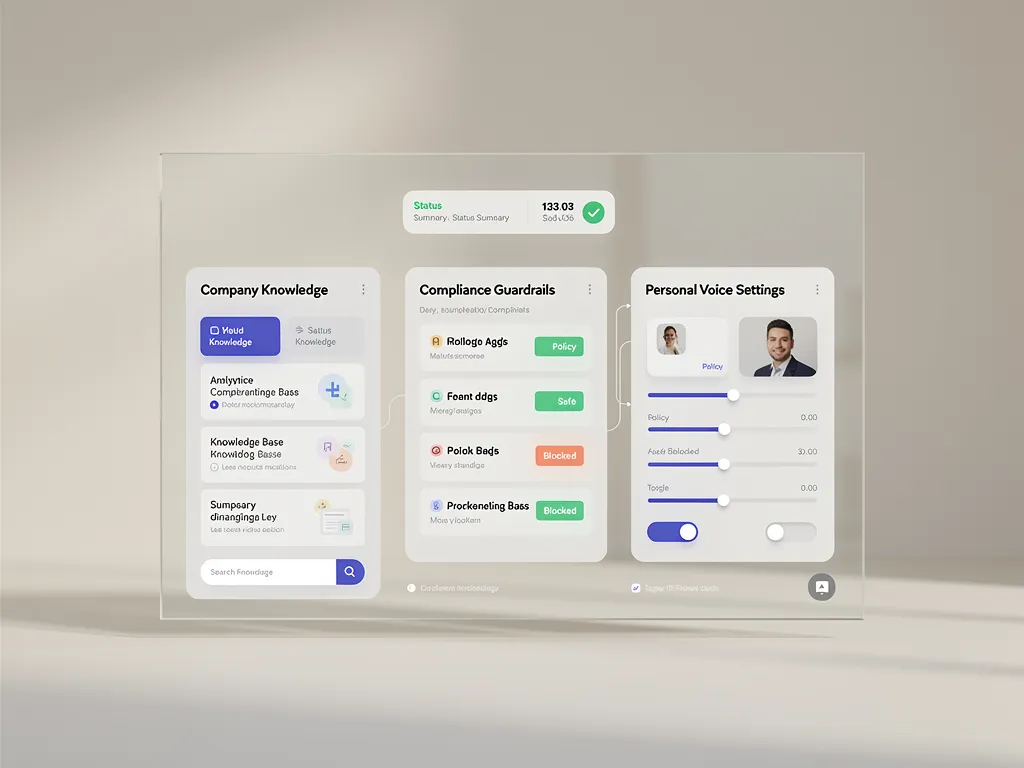
ekko is designed for organizations that want to support LinkedIn content creation across sales teams, executives, and other employees while maintaining organizational alignment.
Its approach combines three elements:
Corporate knowledge: Company information and approved messaging provide a foundation for content generation.
Compliance rules: Organizational guardrails help guide content toward established requirements.
Personal voice: Voice development helps generated posts reflect each contributor’s writing style rather than applying one generic tone to every employee.
These elements support a more consistent content workflow. Instead of treating individual voice, company knowledge, and compliance as separate activities, ekko brings them together within its content generation approach.
For organizations operating in regulated industries, the appropriate review and approval process remains essential. Teams should configure their workflows to match their own legal obligations, risk levels, and internal policies, and should not treat AI-generated content as automatically approved for publication.
The result is a more structured way to help employees participate in LinkedIn content programs while keeping company messaging and individual communication styles aligned.
Common LinkedIn Compliance Mistakes to Avoid
Even organizations with formal policies can encounter preventable issues:
Publishing before required approval can leave an unverified claim or missing disclosure live on a profile.
Using outdated information means previously approved content may no longer reflect current products, services, evidence, or policies.
Assuming a disclaimer fixes everything overlooks that disclosures provide context but don’t make misleading or unsupported statements acceptable.
Sharing customer stories without permission risks revealing sensitive information that requires authorization.
Relying entirely on AI checks can miss context, subtle implications, or industry-specific requirements.
Failing to retain records makes it difficult to demonstrate how a communication was reviewed when records are required.
Preventing these problems requires clear ownership, practical training, suitable review procedures, and ongoing monitoring.
Measuring the Effectiveness of Your Compliance Process
A compliance workflow should protect the organization while allowing employees to communicate consistently and efficiently.
Consider tracking the following operational measures:
Percentage of posts that complete required approval before publication.
Average time from draft submission to approval.
Number of posts returned for corrections.
Frequency of recurring content errors.
Employee participation in training.
Completeness of required approval and publishing records.
These measures can help identify bottlenecks and areas for improvement. Interpret them in context: a higher correction rate may indicate better detection rather than worse employee performance, while a fast approval time does not necessarily demonstrate compliance.
Organizations should evaluate process quality alongside their actual regulatory obligations and the effectiveness of their controls.
Frequently Asked Questions
What is LinkedIn compliance for regulated industries?
LinkedIn compliance for regulated industries means managing professional social media communications according to the legal, regulatory, and internal requirements that apply to an organization. Depending on the industry, this can include accurate claims, required disclosures, confidentiality, approval procedures, and recordkeeping.
Do all LinkedIn posts need compliance approval?
Not necessarily. Requirements vary by organization, industry, jurisdiction, and content type. Some organizations permit employees to publish lower-risk content under established guidelines, while other communications require specific supervisory or compliance approval.
Can employees in regulated industries post on personal LinkedIn profiles?
Often, yes, subject to applicable rules and company policies. Employees should understand their responsibilities when discussing their employer, regulated products, customers, or professional services. Personal profiles do not automatically remove relevant legal or professional obligations.
Can AI generate compliant LinkedIn posts?
AI can help draft content using approved information and defined guidelines, but it cannot guarantee compliance. Factual verification, appropriate human review, and any required approvals remain important, particularly for high-risk communications.
How can companies manage employee advocacy without losing control?
Companies can establish clear social media policies, maintain approved company information, define risk-based approval procedures, train employees, and use suitable tools to coordinate content and reviews. The aim is to give employees clear boundaries rather than prevent them from sharing professional knowledge.
What should a LinkedIn compliance checklist include?
A useful checklist should cover factual accuracy, substantiation of claims, confidential information, required disclosures, approved messaging, links and visual assets, required approvals, and recordkeeping. The final checklist should reflect the organization’s specific industry and legal requirements.
Conclusion
LinkedIn creates opportunities for regulated organizations to share expertise, develop professional relationships, and expand employee advocacy. Achieving those benefits requires more than telling employees to avoid risky posts.
LinkedIn compliance for regulated industries works best when clear policies, approved company information, risk-based reviews, employee training, and appropriate recordkeeping form part of a consistent workflow.
AI can help teams draft and organize content more efficiently, but technology should support—not replace—qualified review and organizational accountability.
With a well-defined governance process and tools designed to bring company knowledge, compliance rules, and individual voice together, organizations can build a more sustainable approach to LinkedIn content without treating every post as an entirely new compliance challenge.