

Fifteen proven LinkedIn hook formulas for B2B posts include specific-number claims, contrarian statements, costly-mistake confessions, and direct questions that resolve clear tension within the first three lines. Since 65% of LinkedIn users decide to expand a post based solely on its opening line, specific hooks drive 2-5X more engagement than generic openers.
What Should a B2B LinkedIn Hook Accomplish?
A strong opening line decides whether a post gets read or buried in the feed. LinkedIn post hooks carry the bulk of a post’s performance: the hook determines 80% of results, and identical content paired with a stronger opening earns 2-5X more engagement. For B2B marketing leaders and employee advocacy managers, that math changes the entire calculus of LinkedIn content strategy.
Readers rarely make it past the fold. The platform shows only the first two to three lines before the “see more” button appears. 65% of users decide whether to expand a post based on that opening line alone. LinkedIn opening lines, then, function less like introductions and more like gatekeepers.
A well-built hook does three things in sequence:
- Stops the scroll with a specific observation, tension, or question.
- Converts a passive viewer into an engaged reader who finishes the post.
- Moves that reader toward an inbound lead over repeated exposure.
That third step matters most for sales executives tracking pipeline, not just likes.
Why does hook quality matter more in 2026 than before?
LinkedIn’s algorithm now rewards relevance, credibility, and consistency instead of raw posting volume. Flooding the feed without a working hook wastes effort the algorithm no longer compensates for.
How do B2B teams scale this without losing authenticity?
Reliable B2B LinkedIn posts require repeatable LinkedIn hook formulas, not one-off inspiration. Teams that build LinkedIn post templates around proven openers, paired with each contributor’s real voice, sustain the consistency the algorithm now favors. Understanding how to write LinkedIn hooks at scale, rather than per-post, is what separates programs that compound visibility from ones that burn out their champions after a few sporadic bursts.

What Do You Need Before Writing Hooks?
A usable hook requires one decision before a single word gets typed: what tension, lesson, or choice will this post actually resolve for the reader? Marketing leaders who skip that step produce generic lines that signal nothing and get scrolled past. Content strategists running a disciplined LinkedIn content strategy treat the hook as the deliverable, not an afterthought bolted onto a finished draft.
Three prerequisites come before any formula gets applied:
- Identify the resolution. Name the specific tension, lesson, or decision the post will settle for a relevant reader.
- Pull the real evidence. Gather the observation, mistake, or contrarian point the body will prove, not a claim invented for effect.
- Check the body matches the claim. Confirm the post can substantiate the opener before publishing; unsupported drama erodes credibility fast.
Enterprise teams building B2B LinkedIn posts at scale often skip step three under deadline pressure, which is exactly where trust breaks.
Why does matching the hook to the body matter so much?
Vague curiosity and invented drama collapse the moment a reader opens the post and finds nothing resolved. That mismatch costs more than a skipped read. It trains the audience to stop trusting future LinkedIn opening lines from that author entirely.
Does content saturation change what counts as “ready”?
Yes. Reach has grown harder to earn, and B2B buyers now filter aggressively against noise. A founder or sales executive without a clear tension to resolve has nothing worth the audience’s shrinking attention, regardless of how polished the LinkedIn hook formulas look on the surface.
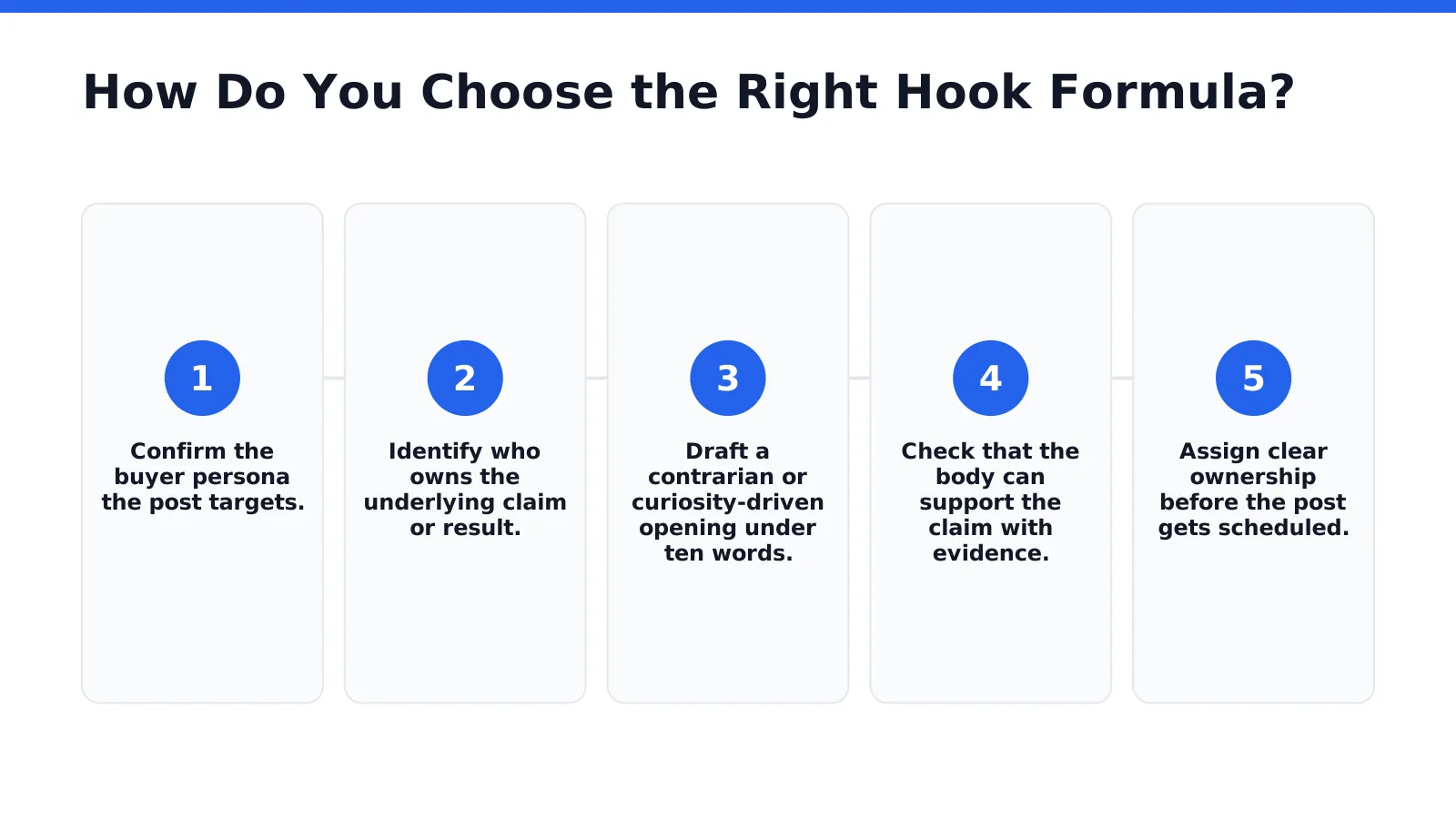
How Do You Choose the Right Hook Formula?
Formula selection starts with the buyer, not the template library. A hook works only when the opening line matches the exact buyer reading it, the people who did the underlying work, and the evidence available once the post goes live. Marketing leaders skip this step at their own cost.
No fashionable format rescues a post built on weak targeting. A trending structure or generic checklist cannot repair unclear ownership or a fuzzy audience definition. LinkedIn content strategy has to settle those questions before anyone touches LinkedIn hook formulas.
What makes one hook formula outperform another?
Curiosity gaps and contrarian statements consistently beat other formula types, delivering more than double the engagement rate of standard openers. For B2B LinkedIn posts, that means leading with a tension or an unexpected claim rather than a apartment announcement. Enterprise content strategists should treat these two formula types as the default starting point, then test variations from there.
Does hook length actually matter?
Length shapes performance more than most teams assume. Hooks under ten words beat longer ones. Brevity reads faster inside a mobile feed and creates intrigue before the “see more” cutoff.
Follow this sequence when building LinkedIn post templates for a sales or leadership team:
- Confirm the buyer persona the post targets.
- Identify who owns the underlying claim or result.
- Draft a contrarian or curiosity-driven opening under ten words.
- Check that the body can support the claim with evidence.
- Assign clear ownership before the post gets scheduled.
Employee advocacy program managers who follow that order avoid the most common failure in LinkedIn opening lines: a catchy line attached to a post nobody can actually substantiate.
Which Eight More Formulas Sustain Engagement?
Eight formulas keep B2B LinkedIn posts performing past the first week: personal-story openers, contrarian framing, numbered-list previews, before/after contrasts, question hooks, myth-correction hooks, data-led statements, and named-employee commentary. Teams building a LinkedIn content strategy for B2B Posts rotate these formulas rather than repeating one pattern. Audiences tire of predictable openers fast. Sales executives and content strategists overseeing B2B Posts programs get the most mileage by matching formula to goal, not to raw reach.
Personal-story hooks deserve top priority. They generate the highest volume of inbound direct messages, even though data-led hooks typically rack up more likes and impressions. A leader posting a first-person account of a deal lost or lesson learned converts better than a chart-heavy statistic post. The story invites a reply instead of a scroll-past.
Employee-voice formulas rank second for the same reason. Posts written in a named colleague’s voice outperform brand-only broadcasts. Buyers extend trust to real people faster than to corporate accounts.
How should a team sequence these formulas across a week?
- Open Monday with a contrarian or myth-correction hook to seed debate early in the week.
- Follow Tuesday with a numbered-list preview summarizing a lesson from B2B Posts campaigns.
- Publish a personal-story hook midweek to drive direct messages.
- Close the week with a data-backed statement crediting a named source.
- Reserve employee-voice posts for milestone or launch announcements tied to B2B Posts.
What formulas should teams avoid?
Automation-flavored hooks and artificial connection-volume gimmicks carry real platform risk. LinkedIn restricts accounts for excessive automated activity or prohibited tools, which makes manufactured urgency a liability rather than an asset.
Choosing formulas deliberately, rather than defaulting to automation shortcuts, keeps LinkedIn opening lines credible and keeps B2B Posts accounts in good standing.
How Do You Build the Post After the Hook?
Structure follows the promise. Once the opening line sets the tension, the body must deliver the single useful idea that the exact reader came to resolve, nothing broader and nothing vague. For B2B marketing leaders publishing B2B LinkedIn posts, this means identifying the one decision-maker the post serves and the one takeaway they need before they close the app.
Building the body is a sequence, not a brainstorm. Follow these steps in order:
- Name the reader explicitly in the first line of the body (a VP of sales, a demand gen lead, a founder evaluating pipeline tools).
- State the single idea the hook promised, in one sentence, with no hedging.
- Support that idea with one concrete example, data point, or observed pattern from the team’s own experience.
- Close with a clear next action: a question, a framework recap, or an invitation to comment.
A platform like ekko, built in Dallas, Texas and serving B2B Posts teams nationwide, structures this sequence into repeatable LinkedIn post templates. Every contributor follows the same logic without starting from a blank page.
Why do yesterday’s post structures stop working?
Formats that drove results twelve to eighteen months ago no longer perform reliably today. Feeds saturate, buyer attention narrows, and a body built on an outdated template reads as generic even with a strong hook. Reviewing structure regularly matters as much as reviewing the opening line.
Does content strategy mean constant reinvention?
No. A durable LinkedIn content strategy adapts how teams write post by post rather than chasing short-lived hacks or vanity metrics. Consistency in the underlying system, paired with periodic structural review, outperforms constant trend-chasing for B2B Posts teams building long-term authority.
How Do You Scale Hooks Across a Team?
Scaling strong openings across a sales floor or leadership bench requires a repeatable system, not individual willpower. A single rep writing clever hooks solves nothing if 40 colleagues across B2B Posts accounts stay silent. ekko generates daily LinkedIn content strategy output calibrated to each leader’s and sales professional’s own voice. Every person posts consistently without the manual grind of drafting fresh hooks each morning.
Consistency breaks down fastest when teams rely on shared documents or copy-paste templates. Everyone starts sounding the same, and buyers notice. A structured platform solves this differently:
- Assign each team member a distinct voice profile rather than a generic brand tone.
- Feed corporate announcements, launches, and milestones into the system so hooks stay current.
- Route every generated post through LinkedIn’s official APIs, keeping distribution compliant and secure at volume.
- Let sales professionals customize the opening line before publishing, preserving authenticity.
Does Scaling Hooks Actually Move Pipeline?
Yes, when hooks are distributed across a full sales team rather than concentrated in one or two accounts. Amplifying social selling efforts through many authentic voices supports pipeline growth and quota achievement more reliably than a single executive’s feed. Volume alone doesn’t work; variation across voices does.
What Infrastructure Supports Hooks at Scale?
Reliability matters more than creativity once a team scales past a handful of posters. ekko runs on CAP Digisoft’s engineering foundation, built over two decades with a focus on reliability and security. That infrastructure layer is what keeps hook execution stable across dozens of accounts in B2B Posts organizations, rather than breaking down under manual oversight.
What Mistakes Kill B2B LinkedIn Hooks?
Invented drama kills B2B LinkedIn posts before the body gets a chance. Manufactured tension and vague curiosity openers that the rest of the post cannot back up erode reader trust fast, leaving skepticism where credibility should sit. A second failure mode treats the post as a shortcut for automated connection volume rather than a surface for demonstrated expertise. LinkedIn’s algorithm punishes that mismatch. Three mistakes repeat across failed LinkedIn post hooks:
- Opening with manufactured stakes the post never resolves.
- Chasing curiosity without a concrete lesson or decision behind it.
- Writing hooks long enough to bury the insight before readers reach it.
Any one of these sinks a strong idea straight into the feed unnoticed.
Why do long hooks underperform?
Length works against the opener more than most marketers assume. Hooks under ten words outperform longer ones. Brevity creates intrigue and fits the mobile feed format. Padding the first line with context cuts that advantage immediately, pushing engagement below what a shorter version earns.
FAQ
What makes a LinkedIn hook effective for B2B posts?
A strong hook stops the scroll with a specific observation, tension, or question, converts passive viewers into engaged readers, and moves readers toward becoming inbound leads over repeated exposure.
Why do opening lines matter so much on LinkedIn?
LinkedIn shows only the first two to three lines before the “see more” button appears. 65% of users decide whether to expand a post based on that opening line alone.
What should teams do before writing a LinkedIn hook?
Teams should identify the specific tension or decision the post will resolve, pull real supporting evidence, and confirm the post body actually substantiates the hook’s claim before publishing.
Conclusion
In closing, mastering these hook formulas transforms LinkedIn from a broadcast channel into a genuine conversation platform where your authentic voice drives engagement and builds trust. The mechanics work because they align with how buyers actually think, they respond to specificity, contradiction, and human insight over corporate polish. Consistency matters more than perfection; deploying these formulas across your team amplifies reach exponentially while maintaining the personal credibility that drives pipeline growth and quota achievement.